
Unit 1: What is Differentiation?

Before completing any reading for this course I made a mind map of what I believe defines differentiated instruction. I thought differentiated instruction was providing support to students in need through a variety of strategies such as adjusting assignment length/requirements, providing tools for the student, and understanding the students areas of weakness. After completing the first unit readings I now understand that differentiated instruction means much more. It means not only providing support for struggling learners to make growth but also challenging advanced learners. It is “a way of thinking about teaching” (Castaneda, 2012, 0:28). Differentiated instruction is being proactive in your teaching to meet the various needs of all students by using assessments, being student-centered, and using multiple means to the content.
I would describe differentiation to a colleague as giving students multiple options for taking in information. It means that you assess, monitor, and observe to understand the differences and similarities of students. I would provide an example using my experience with the Learner Sketch Tool. I took the assessment to find my areas of strength and weakness and discovered some strategies that I can use to help improve my weak areas. Using my experience I would explain that some students may need to see information, not just hear it in a lecture. Some students may need processing time to gather their thoughts before responding to a question. “Learning matches learner need” (Tomlinson, 2001, p. 15). You need to understand your students strengths and struggles and use this to plan instruction.
To help explain differentiation to students I would place an item high enough for my tallest student to reach. I would ask my tallest student and shortest student to try to grab the item. When the tall student retrieves the item with ease I would have students stop to think about what tools the shorter student could have used to help him/her reach the item. When students share out stool, chair, ladder, etc. I would state that it was differentiation is, tools to help us reach something like a goal. I would continue to explain to students that sometimes we are good in math but need some tools to help us with reading or sometimes we are good in reading but we need tools to help with math. Some people may use the same tools but sometimes our tools are different.
As a third grade teacher I will use differentiated instruction regularly in the classroom. Every year I have new students and every year there are a variety of needs. I can adjust strategies and tools from previous experiences to meet the needs of current and future students. I can continue to learn new ways to support my students within the classroom. Tomlinson states, “Our students – each of them – is a message that we can never stop attending to the craftsmanship and artistry of teaching” (2001, p. 9). I will always find ways to meet the needs of my students to help them learn.
One thing I want to learn more about it is providing the appropriate level of challenge to my advanced learners. At times I feel they are given busy work and I don’t know where to start to provide the appropriate level of challenge and support to them.
One idea for implementation in the classroom is providing multiple approaches to learning in math. Some students may like to complete their math work on white boards, some may show using tiles, some may want to write it out on paper, and some may want to verbally express their thinking.
Reference:
Castaneda, R. (2012, July 10). What is Differentiated Instruction [Video file]. Retrieved from https://www.youtube.com/watch?v=bApuBiitL8Q
Tomlinson, C.A. (2001). How to differentiate instruction in mixed-ability classrooms. Alexandria, VA: Association for Supervision and Curriculum Development. Retrieved from https://ebookcentral-proquest-com.postu.idm.oclc.org/lib/post/reader.action?docID=280341&ppg=17
Unit 2: Analyzing and Evaluating a Research Article
The article Ability Grouping and Differentiated Instruction in an Era of Data-Driven Decision Making focuses on exploring uses of data for ability grouping and differentiated instruction (DI). Questions asked in the article: “What are the district and school level factors that shape how teachers differentiate instruction or group students? What are the various logics that inform how teachers construct DI and ability grouping? What types of data are used to inform teachers’ decision making about DI and student grouping?” (Datnow & Park, 2017, p. 282). These questions are relevant to understanding how teachers, schools, and districts meet the needs of students through ability grouping and DI. “We find that although differentiation has often been thought of as a teacher-level decision, in actuality, decisions at the school and district levels guide teacher sense-making about DI in significant ways. The use of data is an important piece of this puzzle” (Datnow & Park, 2017, p. 283).
Participants selected for this research include teachers and teacher teams in four public elementary schools. “We gathered data during the 2014-2015 school year through semi structured interviews with 27 teachers, principals, and other key personnel and through 127 hours of observations data” (Datnow & Park, 2017, p. 288). The authors detail a thorough interview process as well as observations and data analysis.
The framework focuses on meeting individualized learning needs through flexible, relevant, and varied student supports including student grouping for instruction. This is relevant to the questions as all decisions regarding student support should be data based. Tomlinson states, “Using a variety of grouping strategies allows you to match students and tasks when necessary, and to observe and assess students in a variety of groupings and task conditions” (2001, p. 26).
This article focuses on exploring uses of data for ability grouping and differentiated instruction. The article does not provide any data on the effects of differentiated instruction as far as student success, meeting student needs, or learning of content. “Making the link between best practice teaching and differentiation helps set the stage for understanding the role of the teacher in a differentiated classroom” (Tomlinson, 2001, p. 17). The primary purpose of this research is to explore how groups are made for differentiated instruction, not the outcome.
The authors examine the types of grouping decisions made, the types of data used to inform the groupings, and the logics used. Research data is first displayed by school, policy, and influence on DI and data use practice. It was further broken down into a table that displayed the type of decision on grouping, the type of data used, logic, and frequency.
The research of this article studied the effects of district and school policies on ability grouping and DI, as well as curriculum tools and classroom demographics. The findings are organized into categories: District and Schools’ Spheres of Influence on Differentiation and Grouping, and Patterns and Logics of Grouping and Differentiation. The findings are clear and helpful in understanding the various means of and influences on creating instructional groups within the classroom and differentiating instruction.
The authors state the limitations in their research in that their focus was on the “overarching patterns and ranges of data-use logics, DI, and the ability grouping across the sites” (Datnow & Park, 2017, p. 303). They stress that more research would be beneficial. It would be helpful to know the impact of the groupings on students to determine their effectiveness. It is unclear if the data used, the people involved in the decision making, and the groupings themselves are beneficial for student success.
From this research I have found that I should use more data to determine groups within my classroom. I should also collaborate with our support staff to discuss groups for the students who receive additional support outside of class.
I would like to find further research that explains the benefits of groupings. Is there a group that works best for a specific content area? How often should groups be adjusted and why?
References
Datnow, A., & Park, V. (2017). Ability grouping and differentiated instruction in an era of data-driven decision making. American Journal for Education, 123(2), 281-307. Retrieved from http://eds.b.ebscohost.com.postu.idm.oclc.org/eds/pdfviewer/pdfviewer?vid=10&sid=5c1cb2de-1af7-4ded-nbf81-c19af09045d5%40pdc-v-sessmgr05
Tomlinson, C. A. (2001). How to differentiate instruction in mixed-ability classrooms. Alexandria, VA: Association for Supervision and Curriculum Development. Retrieved from https://ebookcentral-proquest-com.postu.idm.oclc.org/lib/post/reader.action?docID=280341&ppg=25
Unit 3: Beliefs Related to Differentiation
I believe that differentiated instruction includes the following strategies: scaffolding, flexible grouping, learning centers, tiered assignments, and varying questions. To support the belief of scaffolding I offer a quote from Ankrum, Genest, & Belcastro, “Scaffolding is a learner-centered construct; as such, instructional scaffolds may take various forms, depending on the needs and strengths of learners (2014, p. 40). The use of scaffolding as an instructional strategy is to guide students toward independence. A teacher provides various levels of scaffolding until the student is able to complete the task/demonstrate understanding of the concept independently. To support the belief in flexible grouping Tomlinson states, “Students are part of many different groups – and sometimes work alone – based on the match of the task to student readiness, interest, or learning style” (2001, p. 102). This strategy allows students to work with a variety of peers, to collaborate, to work cooperatively, and also work independently. To support the belief in learning centers I offer a quote from O’Donnell & Hitpas, “Offering choices help differentiate instruction in order to better educate diverse learners” (2010, p. 2). Students need choices within learning centers to develop and reinforce skills and strategies. The teacher acts as a facilitator to support students as needed, restate expectation, and may also pull small instruction groups during this time. The following statement by Tomlinson supports the belief in tiered assignments. “Tiered assignments allow for students to begin learning from where they are and to work with appropriately challenging tasks. It also allows for reinforcement and extension of concepts and principles based on student readiness as well as modification of working conditions based on learning style” (Tomlinson, 2001, p. 101). Finally, to support the belief of varying questions I offer this statement by Tomlinson, “Teachers can ‘try out’ students with varied sorts of questions as one means of assessing student progress and readiness” (2001, p. 104). Using varying questions can help build confidence and motivation students and help students build their knowledge from others answers.
Regarding Tomlinson’s idea of compacting, I believe it may be a beneficial strategy to use for differentiated instruction in my third-grade classroom. To support this belief, I offer Tomlinson’s description of the strategy. “A 3-step process that (1) assesses what a student knows about material to be studied and what the student still needs to master, (2) plans for learning what is not known and excuses student from what is knows, and (3) plans for freed-up time to be spend in enriched or accelerated study” (Tomlinson, 2001, p. 98). I believe this strategy would be beneficial for advanced learners, so they are not bored with the content and are appropriately challenged.
I would like to learn more about compacting and how it can be implemented in my third-grade classroom setting. I think it would help me differentiate for advanced students. I would like to try implementing flexible grouping based on student interest. I usually create flexible groups based on skills, strategies, random selection, and student choice.
Reference
Ankrum, J., Genest, M., & Belcastro, E. (2014). The power of verbal scaffolding: ‘Showing’ beginning readers how to use reading strategies. Early Childhood Education Journal, (42/1), p. 39-47. Retrieved from http://eds.a.ebscohost.com.postu.idm.oclc.org/eds/detail/detail?vid=29&sid=1af8353b-4a65-42d1-b425-a07acd14b849%40sessionmgr4006&bdata=JnNpdGU9ZWRzLWxpdmUmc2NvcGU9c2l0ZQ%3d%3d#AN=93751050&db=mfi
O’Donnell, B. & Hitpas, R. (2010). Two teachers learn from their students: Examining teaching, learning, and the use of learning centers. Networks: An Online Journal for Teacher Research, (12/2), p. 1-8. Retrieved from http://eds.a.ebscohost.com.postu.idm.oclc.org/eds/detail/detail?vid=36&sid=1af8353b-4a65-42d1-b425-a07acd14b849%40sessionmgr4006&bdata=JnNpdGU9ZWRzLWxpdmUmc2NvcGU9c2l0ZQ%3d%3d#db=eue&AN=64362437
Tomlinson, C. A. (2001). How to differentiate instruction in mixed-ability classrooms. Alexandria, VA: Association for Supervision and Curriculum Development. Retrieved from https://ebookcentral-proquest-com.postu.idm.oclc.org/lib/post/reader.action?docID=280341&ppg=25
Unit 4: DI Strategy
The jigsaw strategy is a strategy I would like to try but I am not sure exactly how to implement in my classroom setting. In the video The Jigsaw Method Jennifer Gonzalez breaks down the jigsaw strategy into easy to understand steps. Gonzalez explains, “The jigsaw is a cooperative learning strategy where each student in a group takes responsibility for one chunk of the content, then teaches it to other group members” (2015, 0:27). She explains the methodology behind the strategy as well as the different approaches to using this strategy. Gonzalez also provides troubleshooting tips for situations that may arise when using the jigsaw method.
From this video I have learned how the groups work together as well as student responsibilities within the group settings. Gonzalez color coded her illustration, which makes it easier to follow and see the responsibilities of each group member. Understanding how this strategy can be used with various content is helpful to generate ideas of how to use this strategy within the classroom. I now have some ideas of how I can implement the jigsaw strategy in my classroom. I could use this strategy when introducing a new topic for social studies. Students could read an informational text that introduces the new topic to build prior knowledge. We could also use this strategy to help review math content before a post assessment. Students could be experts on a 2-3 review questions and help teach others how to solve the problems. The jigsaw strategy allows students the opportunity to learn from one another and it also makes students accountable for their own learning.
I do have some questions remaining regarding the jigsaw strategies. Does this strategy work best with mixed ability groups? What is the best way to introduce this strategy to third graders? How much time is allotted to each of the groups (jigsaw and expert groups)? I am going to research more on this strategy to determine the best way to implement jigsaw with my students.
Reference
Gonzalez, J. [Cult of Pedagogy]. (2015, Apr. 15). The Jigsaw Method . Retrieved from https://www.youtube.com/watch?v=euhtXUgBEts
Unit 5: Bloom’s Taxonomy and 4 MAT model
Bloom’s Taxonomy, originally created in 1956 by Benjamin Bloom, has been a long-standing source for educators when determining lesson objectives. Bloom’s Taxonomy was later revised in 2001. “Anderson and Krathwohl, back in 2001, worked on a revised version of restating the Bloom’s Taxonomy in verb format, facilitating the process of writing learning objectives by providing Instructional Designers with a list of verbs they can use to help their audience understand exactly what is expected of them” (Pappas, 2015, para 9). Either version can be utilized by an educator to create learning objectives that build upon student knowledge and understanding of the content.
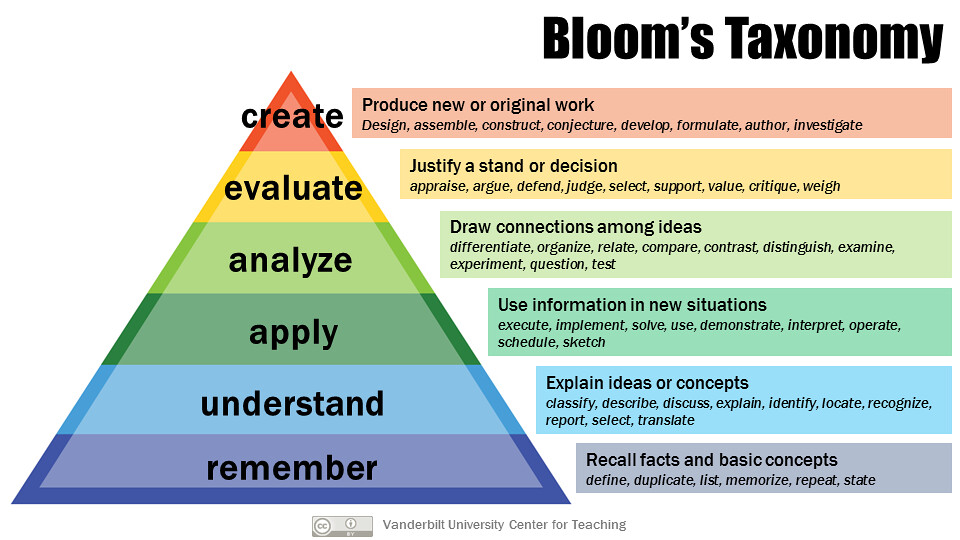
Using the most recent version of Bloom’s Taxonomy, the 6 steps apply to my professional context.
- When beginning a new unit, I will ask students to REMEMBER. This may be calling on students’ prior knowledge, showing them the “big picture” in advance as we build to that point, or to relate the content to something they have already learned. I will usually start by asking students what they already know about the content to see who already knows some of the information and if I need to go back further to review other information before beginning.
- The UNDERSTAND step is the delivery of information that students are to learn, this step may come in many forms. Students may participate in small group or class discussions, they may be note taking, or they may be asked to restate the information in their own words. I have found that the more students are engaged in a lesson the more they will understand.
- The next step is asking students to APPLY their learning, this is the practice component. In my classroom we use the “I do, we do, you do” gradual release model. This would be the step when students demonstrate what they understand from the lesson.
- Next, we ANALYZE our work in meeting the objective. During this step students may review their answers with a peer, it may be a whole class check in, or maybe students who are struggling realize they do not fully understand so they ask the teacher for support. During this step I am checking in with students and asking them questions about the content to determine their understanding.
- During the EVALUATE step students are showing what they know. This may come in many forms from an exit ticket, quiz, debate, or even a self-assessment for students. Evaluating a student at this point helps an educator determine if a student needs additional time or support, if a whole class reteach is needed, or if students have the knowledge and understanding to meet the learning objective.
- The final step is CREATE, students produce a final product that demonstrates their understanding of the content. Students may create a project, report, or speech to share their knowledge and demonstrate what they have learned from the unit. I have utilized many formats to include technology, group projects, and student choice to demonstrate what they have learned.
Bloom’s Taxonomy and the 4 MAT model are similar in many areas. Bloom’s first step and the first step in 4 MAT both include building the connection of the content to the learner. Building on students’ prior knowledge and helping students connect to the content helps with the level of engagement in the lesson. Bloom’s UNDERSTAND step can relate to both Step 3 (Imaging) and Step 4 (Delivering Information) of the 4 MAT model. They all depend on how the information is delivered to the learner and what sources are used in that delivery. Bloom’s APPLY step directly correlates to the Practicing step of 4 MAT as they both have students demonstrate their understanding by practicing what they have learned. Bloom’s ANALYZE step and the 4 MAT step of Extending the Learning are a little different in that I believe Bloom’s step encourages an educator to check in with all students and the 4 MAT model wants to challenge only the learners who understand the content. Both models have a step in which the educator should determine the readiness of students, Bloom’s EVALUATE and 4 MAT’s Refining the Performance. The final step for both models asks students to demonstrate their learning by producing, that would be Bloom’s CREATE step and The Final Performance for 4 MAT.
I have learned the Bloom’s Taxonomy can be utilized in differentiating instruction. Using Bloom’s action words can help determine ways in which students can demonstrate their learning as well as providing differentiation. I would like to use the 4 MAT model as a teaching tool in my classroom going forward.
References
Pappas, C. (2015, August 15). Writing Learning Objectives for eLearning: What eLearning Professionals Should Know. eLearning Industry. Retrieved from https://elearningindustry.com/writing-learning-objectives-for-elearning-what-elearning-professionals-should-know
Vandy CFT. (nd). “Bloom’s Taxonomy” [image]. Retrieved from https://search.creativecommons.org/photos/7e7c0a4f-d038-43d0-8376-6f42bca3f215
Unit 6: Differentiating Content, Process, and Product
In my professional context I am continuously differentiating to meet the various needs of my students. Three ways to differentiate are content, process, and product.
Tomlinson (2001) states, “First, in differentiating content, we can adapt what we teach. Second, we can adapt or modify how we give students access to what we want them to learn” (p. 72). I find that using a workshop model in reading helps to differentiate content to meet the various needs of students. In reading I begin with a mini-lesson and use a mentor text. We focus on one skill or strategy and I model using the mentor text for students. I will then scaffold to have students model using the mentor text with support. Students are then asked to do the same skill/strategy using their own reading books. Students have choice when picking out the books they want to read but they also must pick books within their reading level band. Meaning if a student is currently reading a level N, he/she may choose a book from levels M, N, or O. While students are reading independently, they must also demonstrate their learning through jots in a notebook or using a graphic organizer. As students are reading, I conference with them one on one to help support their learning of the skill/strategy. I will also meet with a small strategy group to reinforce/reteach the learning and provide more guidance to those students. There are also times when students will read with a reading partner; they choose a text to read together and work together to demonstrate their learning of the skill/strategy.
For example: When students were learning about characters and character traits, we used Stone Fox as our mentor text. As I was modeling, I focused on the character “Little Willy” to demonstrate how to identify character traits based off of what the character says and does. I created a chart to write the traits for “Little Willy” and I provided evidence from the text to support it. I only modeled one trait then had students volunteer other traits and provide evidence. When students were asked to do this on their own, they were each provided with a graphic organizer to help them organize their work. They used their own fiction books that they chose at their reading level band. I did meet with a small group of students at the beginning to help reinforce the skill of identifying character traits (they wanted to write down the characters’ feelings, which is a common mistake). Students were able to model their learning of character traits by using books they were interested in and books that were on their reading level.
Another way to differentiate is through the process. “Process means sensemaking or, just as it sounds, opportunity for learners to process the content or ideas and skills to which they have been introduced” (Tomlinson, 2001, p. 79). In math I use somewhat of a workshop model to help students learn the content. I utilize tools for students to use that will provide a physical representation of the skills/strategies we are currently learning. Small groups and partners are also strategies that I use for math. With partners I tend to pair a more advanced student with a struggling student. The advanced students act as a peer mentor to help their peer understand the content better. I tend to pull students who are having a difficult time understanding the current content into a small group to reteach and support the learner. This group changes depending on the content and how well students are learning the skills/strategies.
Recently students have been learning how to find and identify area and perimeter of rectangular figures. Students were introduced to 1-inch tiles and graph paper to help them understand how to count the side lengths. They then were able to add the sides for the perimeter. For area students learned how to count each tile or each space within the figure on graph paper. This led students to understanding that eventually you can find the perimeter by adding all of the side lengths and find area by multiplying length times width. These tools have also helped students in finding a missing side length as well. The tiles have been helpful for struggling students to physically count the tiles when working in small groups. I have noticed a gradual release for many of the students, moving from needing the tiles to find area and/or perimeter to not needing them at all.
Tomlinson (2001) states, “Products are important not only because they represent your students’ extensive understanding and applications, but also because they are the element of curriculum students can most directly ‘own’” (p. 85). Nothing is more defeating that struggling to complete a product that you have no interest in at all. I believe products should be engaging, exciting, and fun while also demonstrating knowledge and understanding. I have differentiated products in a variety of ways, usually by offering students choices. When possible, I let students determine their topic, one that is interesting to them and they enjoy. I also like to give students choices on how they demonstrate their learning by allowing students to determine the best way they would like to present their information. I will provide a rubric, model, and graphic organizers to help them along the way.
I find that I can differentiate the product regularly in reading and writing. My students are currently working on a biography project as we end our reading biographies unit. Throughout the unit students read multiple biographies to learn about a variety of historical figures. Students learned to identify the struggles/obstacles the person faced as well as their accomplishments. We created a historical timeline to document the era in which the people lived and to gain an understanding of the social and political aspects of that era as well. For this product students chose who they wanted to learn more about. They received a packet with the rubric, pictures of previous student work, graphic organizers, and check in dates. Students get to decide how they want to present their information to the class. They can choose to write a report, create a poster, make a brochure, dress up as their person to tell about him/her, or if they have a different idea, they can bring it to me for approval. Students have become very engaged and excited for this project. The goal is that students will identify struggles/obstacles and accomplishments for their person as well as dates.
Learning is not one size fits all. Teachers must differentiate to meet the various needs of the students. By differentiating the content, process, and product a teacher will be able to meet many students’ needs at any given time. “At its most basic level, differentiating instruction means ‘shaking up’ what goes on in the classroom so that students have multiple options for taking in information, making sense of ideas, and expressing what they learn” (Tomlinson, 2001, p. 1). I am realizing that I do differentiate in my classroom but I could be doing more on a daily basis. I would like to find more ways to differentiate daily in my classroom and I would like to implement the use of exit tickets to help me do so.
Reference
Tomlinson, C. A. (2001). How to differentiate instruction in mixed-ability classrooms. Alexandria, VA: Association for Supervision and Curriculum Development. Retrieved from https://ebookcentral-proquest-com.postu.idm.oclc.org/lib/post/reader.action?docID=280341
Unit 7: Analyzing and Evaluating a Research Article
The purpose of the article, Accommodating differences: variations in differentiated literacy instruction in grade 2/3 classrooms, is to inform the reader of why and how to differentiate instruction in literacy. The research of the article included “Ten teachers from Aberdeen School District (pseudonym), who were assigned mixed-grade classrooms, took part in the study” (Tobin & McInnes, 2008, p. 5). Only two of the ten teachers are highlighted in this article. All of the teachers participated in workshops that helped them develop a framework for differentiation and received help and materials to help them meet the needs of a diverse student population.
The authors described how the two participating teachers are alike and different. They are similar in that they both participate in professional development to learn more, they are skilled, creative teachers who support student learning, they support student choice, and they have access to a large number of children’s books. They are different in that one is a veteran teacher of 25 years and the other is fairly new with only 6 years experience. Both teachers utilize the differentiation strategy of scaffolding, while the newer teacher also uses tiered assignments to meet the various needs of students.
Tobin and McInnes state, “Although teachers are acutely aware of variance in students’ literacy needs, many are unsure exactly how to support these needs in the dynamic classroom” (2008, p. 3). Questions that are asked from this article include:
How do teachers come to understand and address the literacy needs of academically diverse learners?
How may differentiated instruction address the needs of struggling literacy learners in the regular classroom?
The authors ask these questions to set the stage of their research. They are interested in finding out how teachers differentiated for literacy learners and how teachers came to understand differentiation.
“The university researchers gathered data in the following ways:
- observational field notes that described any aspect of instruction relevant to a teachers’ understanding of, or attempt to address, the needs of academically diverse learners;
- video recordings of each classroom;
- audio recordings of interviews with the teachers; and
- collections of student assignments, and literacy centre materials, when possible” (Tobin & McInnes, 2008, p. 5).
The data was analyzed by the researchers as well as the participating teachers. “Member checks were conducted by giving teachers an opportunity to view videotapes and to offer their interpretations, which were then folded into the analysis” (Tobin & McInnes, 2008, p. 5). In the article the authors explain how each teacher differentiated to meet the needs of various students. They provided specific examples as to the needs of an individual student and what instructional strategy was used. Then they explained how that strategy meets the literacy needs for that particular student. This is helpful in making connections as to how these strategies could be used in my classroom with similar students.
This research article helps someone identify and understand differentiation strategies that can be used in literacy. The authors only provide details for two of the ten teachers who participated so it is unknow if the other eight teachers used similar strategies, if they were ineffective, or if they used additional strategies that could add to this research article. The authors do provide an illustration for the work products of one teacher which is explains how each product is tiered to meet student needs. Another illustration from the other participating teacher show a “Reading-Tac-Toe” (Tobin & McInnes, 2008, p. 8) for response options. Again, these are helpful to a teacher reading the article to generate ideas of how this can be implemented in the classroom.
“DI provides opportunities for students to work independently and with others on authentic learning tasks, while providing explicit instruction on reading and writing strategies, and creating a motivating and supportive literacy environment” (Tobin & McInnes, 2008, p. 8). I think this article could have used assessment data to prove how these strategies supported student learning. Were students successful in understanding the content of a literacy unit with these strategies?
From viewing and analyzing this article I now have some ideas on how I create tiered learning assignments for my students. The two illustrations from the article were helpful to understand how the tiered assignments meet the needs of the students. I would like to learn more about how to incorporate tiered assignments with the reading and writing curriculum I have within my organization.
Reference
Tobin, R. & McInnes, A. (2008). Accommodating differences: variations in differentiated literacy instruction in grade 2/3 classrooms. Literacy, 42(1), p. 3-9. Retrieved from http://eds.b.ebscohost.com.postu.idm.oclc.org/eds/detail/detail?vid=11&sid=d346c39a-905b-47a5-b921-f9dc10dd6e00%40sessionmgr102&bdata=JnNpdGU9ZWRzLWxpdmUmc2NvcGU9c2l0ZQ%3d%3d#db=eue&AN=31207031
Unit 8: Reflection

“Instead of expecting learners to adjust to the lessons they plan, teachers need to plan their lessons to adjust to the learners at hand” (Corley, 2005, p. 13). Throughout this course I have learned more about differentiated instruction and what it truly means to differentiate. I went from thinking that there were only a few components to differentiation and that it was primarily about the process of learning. I now realize that it is so much more. My end of course mind map reflects my learning from EDU 605. Everything on the right side reflects what I believe differentiated instruction to be. The teal connectors are what I learned after just the first unit. The purple connectors are what I have added at the end of the course.
I have learned about strategies to support student learning such as the jigsaw method and tiered assignments. I plan to incorporate both of the strategies in my classroom regularly. I have learned that supporting struggling learners is not simply having them do less work and supporting advanced learners does not mean giving them more work. “A teacher’s goal is to make everybody’s task a little bit too hard for them” (Castaneda, 2012, 1:17). I now understand that to effectively differentiate for my students I need to consider the content, process, and product of the lesson as well as the readiness, interests, and learning profiles of the students to determine how best to support them and help them obtain the learning outcome. Differentiation is creating “different avenues to acquiring content to processing or making sense of ideas, and to developing products so that each student can learn effectively” (Tomlinson, 2001, p. 1).
References
Castaneda, R. (2012, July 10). What is Differentiated Instruction [Video file]. Retrieved from https://www.youtube.com/watch?v=bApuBiitL8Q
Corley, M. A. (2005, March). Differentiated instruction: adjusting to the needs of all learners. National Center for the Study of Adult Learning and Literacy, 7(C). Retrieved from https://learn-us-east-1-prod-fleet01-xythos.s3.us-east-1.amazonaws.com/5d48331b24326/854445?response-content-disposition=inline%3B%20filename%2A%3DUTF-8%27%27Adult%2520Learning%2520Article-Differentiated%2520Instruction%2520by%2520Mary%2520Ann%2520Corley.pdf&response-content-type=application%2Fpdf&X-Amz-Algorithm=AWS4-HMAC-SHA256&X-Amz-Date=20200301T181422Z&X-Amz-SignedHeaders=host&X-Amz-Expires=21599&X-Amz-Credential=AKIAZH6WM4PLTYPZRQMY%2F20200301%2Fus-east-1%2Fs3%2Faws4_request&X-Amz-Signature=2245904239933a7dfff0347f5502636e716219d187483f049569ce76674e34f0
Tomlinson, C.A. (2001). How to differentiate instruction in mixed-ability classrooms. Alexandria, VA: Association for Supervision and Curriculum Development. Retrieved from https://ebookcentral-proquest-com.postu.idm.oclc.org/lib/post/reader.action?docID=280341&ppg=17
Unit 8: Applied Project
Taking what I have learned throughout this course I created a lesson that I plan to use within the next few weeks. Our opinion writing unit currently lacks differentiation. The strategies I have used in my plan will meet various students needs and encourage students to write more. I am excited to apply my learning to the setting in which I teach.
To view the lesson plan presentation please copy and paste the link: https://docs.google.com/presentation/d/1f60uney0mDzeMqg9bkRk8QlEHtL-nYy9YPSWnz1QPIM/edit?usp=sharing
 Mrs. Jackson